

According to the latest report from QYResearch, Global and China Solar Charge Controller Market Status and Future Development Trends 2026-2032, global solar charge controller sales reached $3.71 billion** in 2025, projected to reach **$12.488 billion by 2032, with a compound annual growth rate (CAGR) of 19.2% from 2026 to 2032.
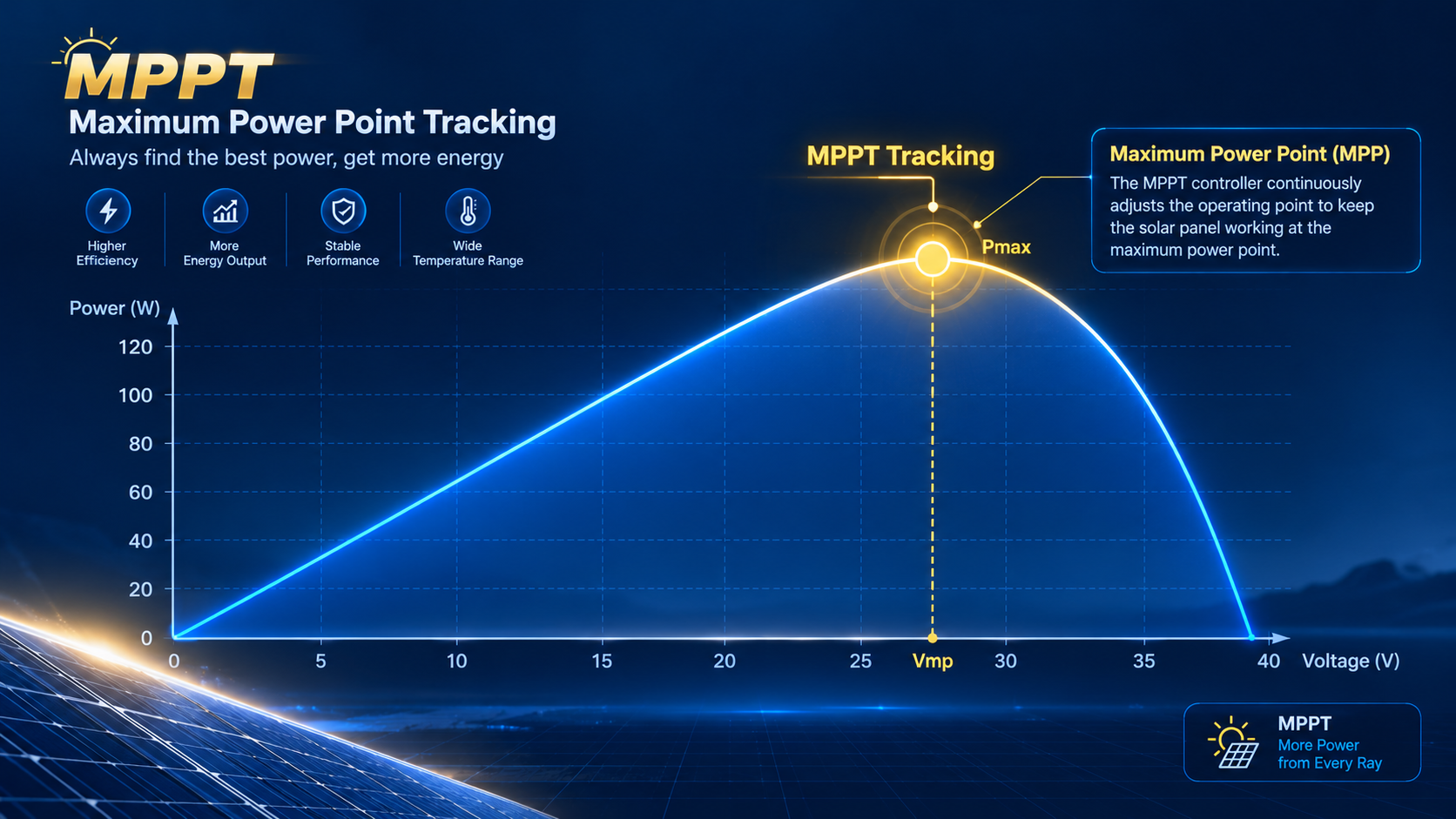
The report notes that high-efficiency products represented by Maximum Power Point Tracking (MPPT) technology are accelerating the replacement of traditional Pulse Width Modulation (PWM) controllers, becoming the core engine of market growth.
The report specifically highlights the driving role of off-grid scenarios in the controller market. Governments worldwide are actively encouraging residential and commercial solar deployment through tax credits and equipment subsidy policies. Particularly, special funding support for off-grid scenarios such as rural electrification and communication base stations has directly driven scaled procurement of controllers.
This assessment aligns closely with actual dynamics in the global off-grid solar market. In regions with weak power infrastructure — Sub-Saharan Africa, Southeast Asia, and Latin America — demand for off-grid and emergency backup controllers maintains rigid growth, making these blue-ocean markets where major manufacturers compete fiercely.
From a regional perspective, Asia-Pacific dominates market growth. China has become a global industry hub through strong manufacturing capabilities and domestic PV installation demand, while rural electrification programs in India and other countries provide substantial incremental space. North American and European markets show a preference for high-value-added products, with users willing to pay premiums for environmental certifications and premium brands.
The report reveals a significant downstream demand shift: in the residential sector, users are no longer satisfied with basic charge/discharge control but are pursuing smart energy gateways with remote monitoring, load management, and grid-support functions.
This means controllers are evolving from “power management devices” into “energy data terminals.” Smart controllers with IoT connectivity, data analytics, and remote management capabilities are becoming the “standard expectation” in the residential market. This trend aligns with Research and Markets’ assessment that AI, remote monitoring, and lithium storage are becoming “standard expectations,” and the market will reward companies with engineering depth, field-proven durability, and regional market alignment.
Meanwhile, commercial and industrial sectors demand high power density and high reliability, requiring controllers to achieve maintenance-free long-term operation in extreme environments such as mines and islands. These requirements align closely with Sukite‘s technical expertise in wide-temperature design, protection ratings, and industrial-grade reliability.
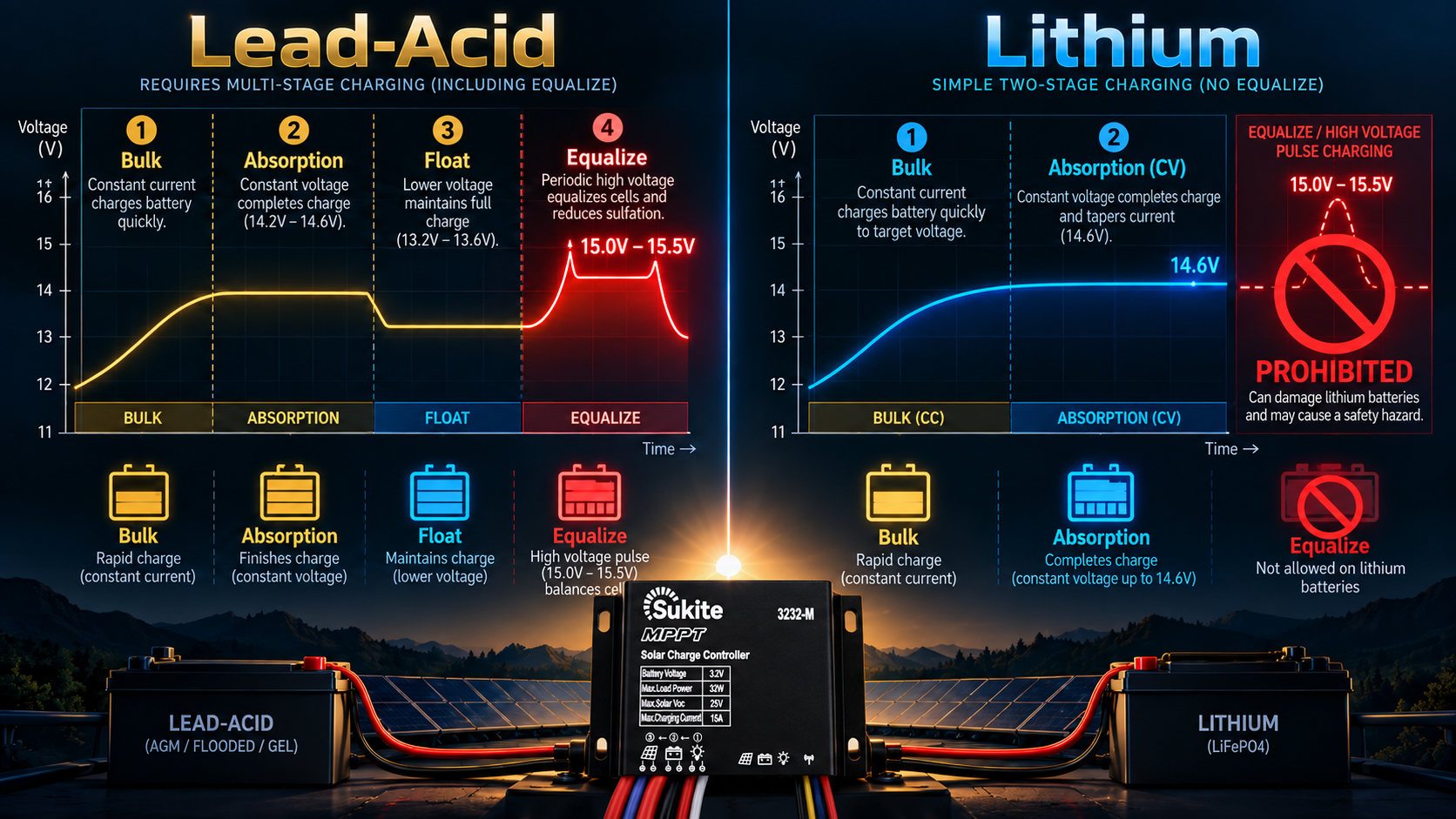
At the battery type level, as lithium battery penetration in energy storage systems rapidly increases, demand for high-precision controllers specifically adapted to lithium charge/discharge characteristics is surging, and traditional lead-acid battery controllers can no longer meet the requirements of emerging chemical energy storage systems.
QYR‘s data and trend analysis provide clear strategic guidance for controller manufacturers:
MPPT is the main track, with massive replacement space remaining. The report notes that MPPT products continue to increase their share in mid-to-high-end markets, energy storage applications, and high-performance off-grid systems due to higher energy conversion efficiency. IndexBox data shows MPPT controllers already hold approximately 55% of the off-grid controller market, but a large base of low-end PWM products still awaits replacement. This means MPPT market growth comes not only from incremental demand but also from replacement of existing installations.
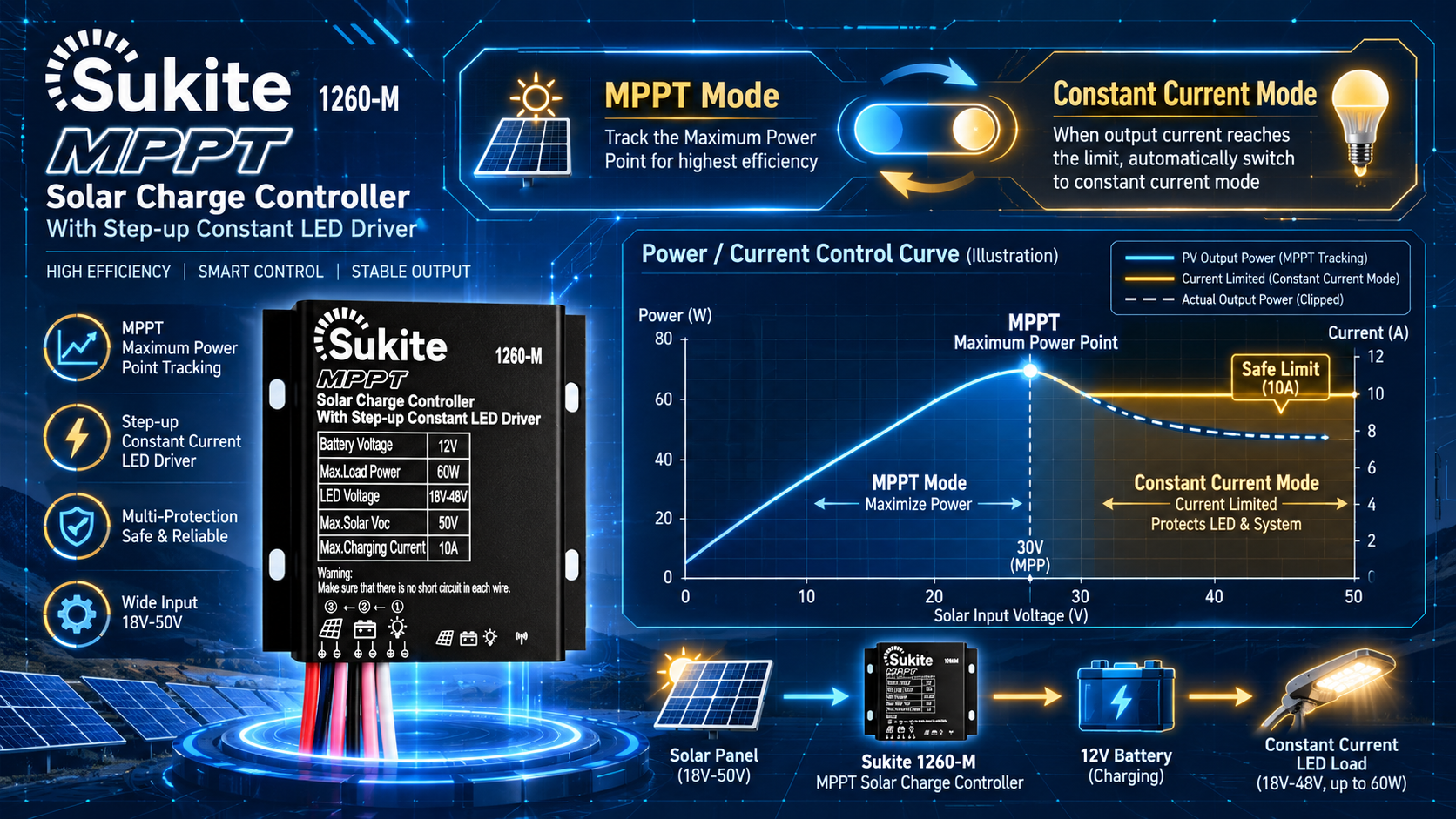
Off-grid scenarios are the core of incremental markets. Special funding support for rural electrification, communication base stations, and mining off-grid scenarios provides predictable procurement windows for controller manufacturers. Sukite’s 3.2V LiFePO₄ series and 24V MPPT product lines are strategically positioned for these scenarios.
Intelligence is the key to differentiated competition. Residential demand for “smart energy gateways” requires controllers with remote monitoring, load management, and data analytics capabilities. Sukite‘s 2.4G wireless communication and IoT controller product lines align with this trend.
Lithium compatibility is the “entry ticket.” With lithium battery penetration in off-grid systems continuing to rise, controllers lacking lithium charging curve optimization and BMS communication capabilities will be phased out of the market.
A $3.71 billion market size and 19.2% CAGR confirm the strategic value of solar charge controllers as the “smart brain” of off-grid and energy-storage PV systems. The accelerated replacement of PWM by MPPT, scaled procurement driven by off-grid special funding, and residential demand upgrade toward “smart energy gateways” together constitute the growth logic for this market over the next six years.
For Sukite, a product strategy centered on MPPT, positioned in off-grid scenarios, and differentiated through intelligence is being validated by this QYResearch industry report.
Data Sources: QYResearch Global and China Solar Charge Controller Market Status and Future Development Trends 2026-2032, IndexBox Off-Grid Controller Market Report, Research and Markets Solar Charge Controller Global Forecast, Straits Research Solar Charge Controller Market Report.
Fill out the form below and our team will get back to you within 24 hours.
Your inquiry has been submitted successfully. Our team will contact you within 24 hours.