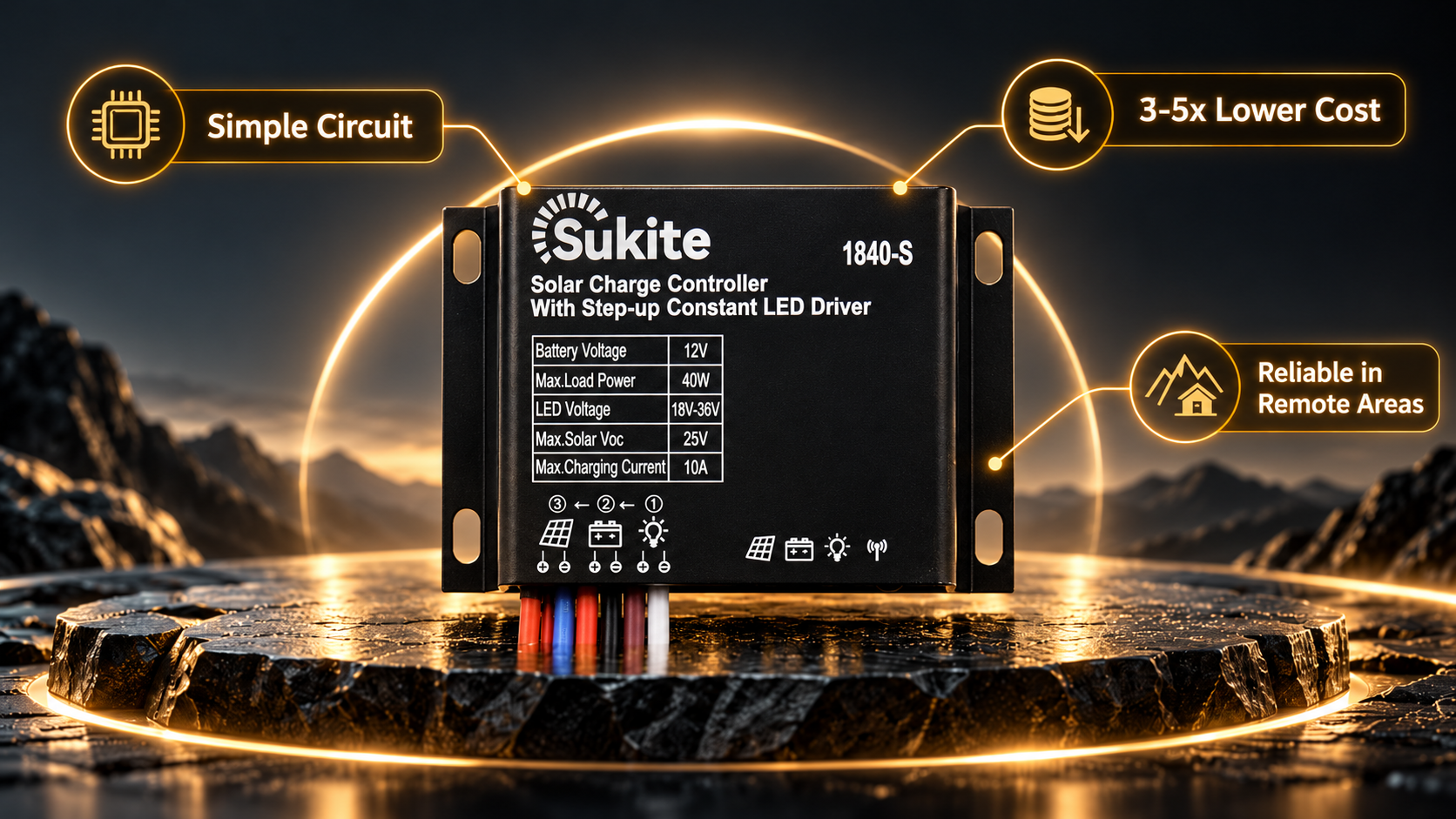


September 15, 2026 — In the routine maintenance of solar street lights, a long-standing pain point persists: controller parameter setting and commissioning require pole climbing. For batch-deployed street light projects — dozens or even hundreds of lights along a single road — this means enormous time costs and safety risks.
The Sukite RC1 Programming & Service Remote Control was designed specifically to address this pain point. Supporting infrared and 2.4G dual-mode communication, it enables ground-level parameter setting, parameter reading, operating status queries, test command transmission, and controller sleep control — upgrading solar street light on-site commissioning and maintenance from “pole climbing” to “ground-level remote operation.”
Traditional solar street light controllers typically use buttons or DIP switches for parameter configuration. After installation, if adjustments are needed — brightness, working periods, battery type, or operating mode — maintenance personnel must climb the light pole and open the controller housing to operate.
For batch-deployed street light projects, the drawbacks of this approach are particularly pronounced: time-consuming, labor-intensive, and carrying safety risks associated with working at height. The RC1 remote control allows maintenance personnel to complete all commissioning work from the ground — no climbing, no housing removal, and no contact with live components.
The RC1‘s most significant technical feature is its infrared and 2.4G dual-mode communication capability.
In infrared mode, the remote’s effective distance is 10 meters, suitable for scenarios requiring precise aiming and close-range operation. In 2.4G mode, the effective distance extends to 15 meters, with no need for precise aiming — offering greater flexibility and convenience.
Switching between the two modes is simple: within 3 seconds after installing batteries, press and hold the “+” key to switch between infrared and 2.4G. A beep confirms successful switching. When “2.4G” appears in the upper-left corner of the screen, 2.4G mode is active; if no mode marker is shown, infrared is the default.
Note that controllers fitted with an induction head support infrared communication only. For these products, the RC1 display should not show “2.4G.” This design ensures users select the correct communication method based on controller type, avoiding communication failure.
The RC1‘s functions cover the complete workflow of solar street light controller maintenance.
Parameter setting and transmission. Press and hold SET for 3 seconds to enter the parameter-setting interface. Users can configure the functional mode (T-Con-Mode for time control or S-Con-Mode for induction control), battery type (Li 3.2V, Li 6.4V, Li 12.8V, Li 11.1V, Lead 12V, Li 25.6V, Li 22.2V, Lead 24V, etc.), load current (0.33A to 10.5A in 0.33A increments), light-control delay (5s to 60s), light sensitivity (H/M/S/L), and multiple working-period time and power parameters. After configuration, press SEND to transmit parameters to the controller. On successful transmission, the controller’s three indicators flash three times simultaneously and the remote displays a completion message.
Parameter reading. Press PRM to read the controller‘s current setting parameters. On successful reading, the controller indicators flash and the RC1 displays the retrieved parameter values. This function is particularly useful for on-site troubleshooting of parameter configuration errors and confirming actual controller settings.
Operating status reading. Press INFO to read the controller’s operating status, including charging state (e.g., CC constant current charging), light status, battery voltage, and remaining nighttime lighting time. Maintenance personnel can fully grasp system operating conditions without opening the controller housing.
Test mode. Press TEST to place the controller into test mode and turn on the load. Repeated presses of TEST switch the test output power through the sequence -5%, -10%, … -100%. Test mode runs for 30 seconds and then automatically returns to normal mode. This function allows installation personnel to quickly verify that luminaires and controllers are working properly — even during daytime.
The RC1 incorporates thorough security considerations.
Password matching mechanism. The controller and RC1 must use the same password for successful communication. The controller‘s initial password is “000000,” and the RC1’s initial default password is also “000000.” Within 3 seconds after installing batteries, press and hold “-” to enter the password-setting interface. Use “+/-” to increase/decrease digits, “▲/▼” to move between password positions, and QUIT to save and exit. When the password is “000000,” no password indicator is displayed in the upper-right corner. After changing to another password, “Password” appears in the upper-right corner. To remove encryption, re-enter the original password, change it to “000000,” and save on exit.
Automatic power management. The remote powers on automatically after battery installation. After 20 seconds without key operation, it enters sleep mode; press any key to wake it. This design effectively extends battery life (3× AAA batteries, 4.5V supply voltage).
Low power consumption and long battery life. Normal power consumption is just 5mA, supporting more than 72 hours of continuous operation. Weighing only 80g (without batteries) and measuring 130×70×20mm, it offers excellent portability.
The RC1 operates across a temperature range of -40°C to +80°C, covering extreme climates from severe cold to intense heat. Its housing is made of ABS + PC material, combining impact resistance and weather resistance to withstand drops, impacts, and temperature variations encountered in outdoor installation and maintenance scenarios.
This wide-temperature design is particularly important for export markets — whether in the scorching deserts of the Middle East, the tropical savannas of Africa, or the harsh winters of Northern Europe, the RC1 performs reliably.
The RC1 also supports controller sleep control. Press and hold QUIT for 3 seconds to place a supported controller into sleep mode — all controller indicators turn off and the remote emits a beep. When a PV panel is connected, sunlight can wake the controller after 5 seconds and normal operation resumes. The controller may also be awakened by sending parameters again, where supported.
Note that only infrared-remote controller products can use the remote to exit controller hibernation; 2.4G remote-control controllers cannot be placed into hibernation by the remote. Controllers with mains complementary power cannot use the remote-control sleep function.
The RC1‘s design positioning makes it particularly valuable in the following scenarios:
Installation and commissioning of batch street light projects. For dozens of solar street lights along a single road, the RC1 enables ground-level parameter configuration for each light — no climbing required, dramatically improving installation efficiency.
Routine maintenance and troubleshooting. Maintenance personnel can periodically use the RC1 to read controller operating status and parameters, promptly identifying issues such as abnormal battery voltage or charging anomalies — enabling preventive maintenance.
Acceptance testing after installation. Using the TEST function, acceptance personnel can quickly verify each street light’s load output during daytime — no need to wait until nightfall.
On-site commissioning for overseas projects. For exported street light projects, the RC1‘s wide-temperature design, Chinese/English interface switching (press and hold “▲” within 3 seconds after battery installation), and dual-mode communication make it adaptable to controller products and usage environments across different countries and regions.
The Sukite RC1 programming remote control combines “IR/2.4G dual-mode communication + full-workflow O&M functions + rugged wide-temperature design” to deliver an efficient, safe, and convenient tool for solar street light controller on-site commissioning and maintenance. It upgrades street light O&M from “pole climbing” to “ground-level remote control,” significantly reducing labor costs and safety risks in batch deployments.
For contractors, O&M service providers, and system integrators planning or operating solar street light projects, the RC1 is a practical tool that genuinely improves maintenance efficiency.
Model: Sukite RC1 Programming & Service Remote Control
Core Functions: IR/2.4G Dual-Mode Communication + Parameter Setting/Reading + Operating Status Query + Test Mode + Password Matching + Sleep Control
Compatible With: Sukite-compatible solar street light controllers
Key Specifications: Effective Distance 10m (IR) / 15m (2.4G) / Operating Temperature -40°C to +80°C / 3× AAA Battery / Weight 80g
Manufacturer: Dongguan Sukite New Energy Lighting Co., Ltd. (Sukite)
Fill out the form below and our team will get back to you within 24 hours.
Your inquiry has been submitted successfully. Our team will contact you within 24 hours.