

In today‘s market where MPPT has become mainstream, PWM controllers are often labeled as “outdated technology.” But the truth is, PWM still has irreplaceable value in specific scenarios. It is not a “phased-out legacy technology,” but a technology path that remains competitive in particular applications.
The core of a PWM controller is a fast switch — no inductor, no complex DC-DC conversion circuit. This means fewer components, lower failure rates, and longer mean time between failures.
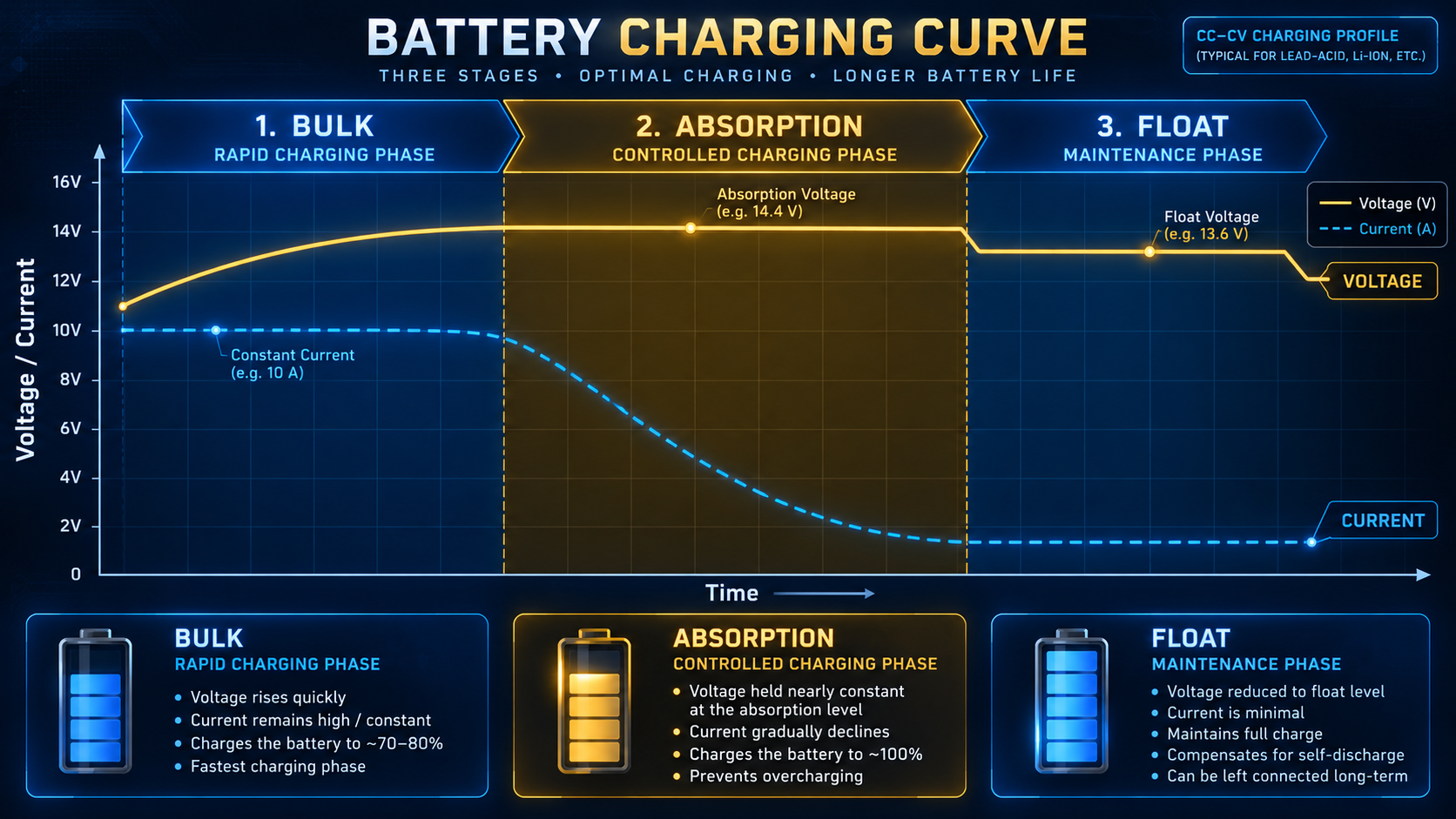
From a circuit structure perspective, a PWM controller is essentially an “intelligent switch.” It connects the solar panel to the battery and controls charging current through rapid on/off switching. When battery voltage is low, the switch stays on for longer periods, allowing more current to flow in. As the battery gradually fills, the switch’s on-time progressively shortens, and charging current decreases accordingly. Throughout the entire process, there is no voltage conversion, no energy being “shuttled” through an inductor, and no high-frequency switching-induced electromagnetic interference or thermal losses.
The direct value of this simplicity is reliability. For remote areas or off-grid systems where maintenance is difficult, “not breaking” matters more than “being efficient.” In regions like Africa and Southeast Asia where grid coverage is inadequate, equipment often needs to run continuously for years without maintenance once installed. A PWM controller with simple circuitry, fewer components, and lower heat generation may deliver more practical value in such scenarios than a more efficient but structurally complex MPPT controller with more failure points.
More importantly, PWM controllers have lower installation environment requirements. They don‘t need to reserve heat dissipation space for inductors and capacitors, so the enclosure can be smaller and more easily sealed to high protection ratings. For space-constrained or harsh-environment applications — such as solar street lights or small surveillance power supplies — PWM’s simple structure is actually an advantage.
The average selling price of MPPT controllers is 3-5 times that of PWM. For extremely budget-sensitive low-power applications, PWM controllers can accomplish the core task of “preventing overcharge and over-discharge” at the lowest possible cost.
The cost difference is structural. MPPT controllers require additional inductors, capacitors, high-performance MOSFETs, and complex control algorithms — the combined cost of these components makes MPPT‘s bill of materials significantly higher than PWM’s. A PWM controller‘s core components are just a switch and basic control circuitry, allowing costs to be compressed to extremely low levels.
For portable solar systems used only for phone charging and LED lighting, users are far more sensitive to price than to efficiency. For a 5W-20W portable solar panel + controller + battery combination, the overall cost of a PWM solution can be a fraction of an MPPT solution. In this scenario, the user’s core needs are “can charge, won‘t damage the battery, cheap” — PWM controllers fully satisfy these requirements.
Similarly, for batch-deployed solar street light projects, although the controller accounts for only a small fraction of system cost, when multiplied by hundreds or even thousands of units, the cost difference becomes significantly amplified. In regions with good sunlight conditions and where efficiency is not an extreme requirement, PWM controllers remain the most cost-effective choice.
MPPT‘s advantage is most pronounced in scenarios with a large “voltage differential.” When system power is very small and the gap between solar panel voltage and battery voltage is limited, MPPT’s conversion losses can consume a significant portion of the “extra gain.”
The principle behind this deserves deeper understanding. MPPT‘s core value lies in converting the solar panel’s “excess” voltage into additional charging current. But this conversion process itself has losses — DC-DC conversion circuits typically operate at 90%-95% efficiency. When the “voltage differential” is small (for example, an 18V panel paired with a 12V battery, a differential of only 4-6V), the extra gain MPPT obtains from voltage conversion is itself modest. After deducting conversion losses, the net benefit may be very limited.
In extreme cases, the MPPT circuit‘s own losses may even exceed the losses caused by voltage mismatch. This is why some high-end controllers incorporate a “bypass mode” — when battery voltage approaches the maximum power point voltage, the MPPT circuit is bypassed and charging proceeds through a simpler direct path. The logic behind this design: under certain conditions, the simplest path is actually the most efficient.
For small off-grid systems, this “certain condition” occurs with reasonable frequency. When the gap between solar panel voltage and battery voltage is limited, PWM’s “direct pass-through” approach actually avoids unnecessary conversion losses.
Understanding PWM‘s three advantages helps us view the relationship between the two technology paths more rationally.
MPPT has clear advantages in the following scenarios: larger system power (typically above 300W), significant voltage differential between solar panel and battery (such as multiple high-voltage panels in series), rapidly changing sunlight conditions (cold, cloudy, partial shading), and applications with explicit charging efficiency requirements.
PWM remains competitive in the following scenarios: smaller system power (typically below 100W), solar panel voltage close to battery voltage (such as 18V panel with 12V battery), extremely budget-sensitive, reliability requirements higher than efficiency requirements, and remote areas where maintenance is difficult.
The two are not a “advanced” versus “outdated” relationship, but rather technology choices for different needs. For controller manufacturers, covering both PWM and MPPT product lines serves a broader customer base. For end users, understanding the applicable boundaries of both technologies enables the most suitable choice for their specific needs.
PWM controllers are not “obsolete” — they have simply found their position in a differentiated market. While MPPT dominates the mid-to-high-end market, PWM continues to play an irreplaceable role in low-power, low-cost, high-reliability scenarios. When choosing a controller, the important question is not “which technology is more advanced,” but “which technology is more suitable for my system.”
Fill out the form below and our team will get back to you within 24 hours.
Your inquiry has been submitted successfully. Our team will contact you within 24 hours.