

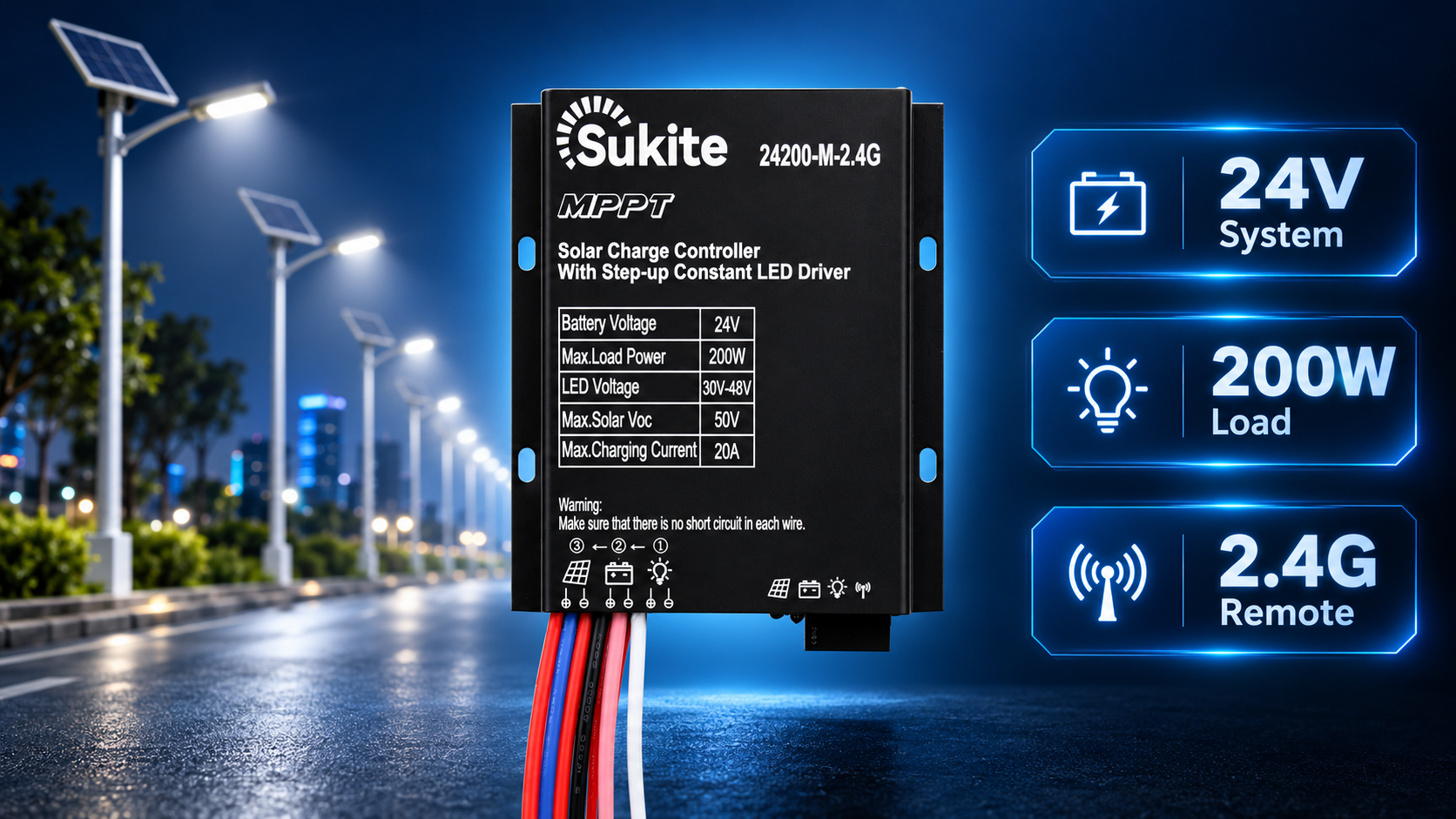
The 2480-M‘s most distinctive feature is its dedicated adaptation for 24V battery systems. The 24V platform holds a unique position in off-grid lighting — compared to 12V systems, it can transmit the same power at lower current, reducing cable losses and heat generation; compared to 48V systems, it offers a more mature supporting ecosystem and lower system costs.
According to the product panel specifications, the 2480-M supports 24V battery systems with a maximum charging current of 10A. For a 24V system, this translates to a theoretical maximum charging power of approximately 240W — sufficient to meet the daily charging requirements of medium-power lighting systems. The maximum solar open-circuit voltage of 50V provides flexible series configuration options for solar panels while maintaining ample safety margin.
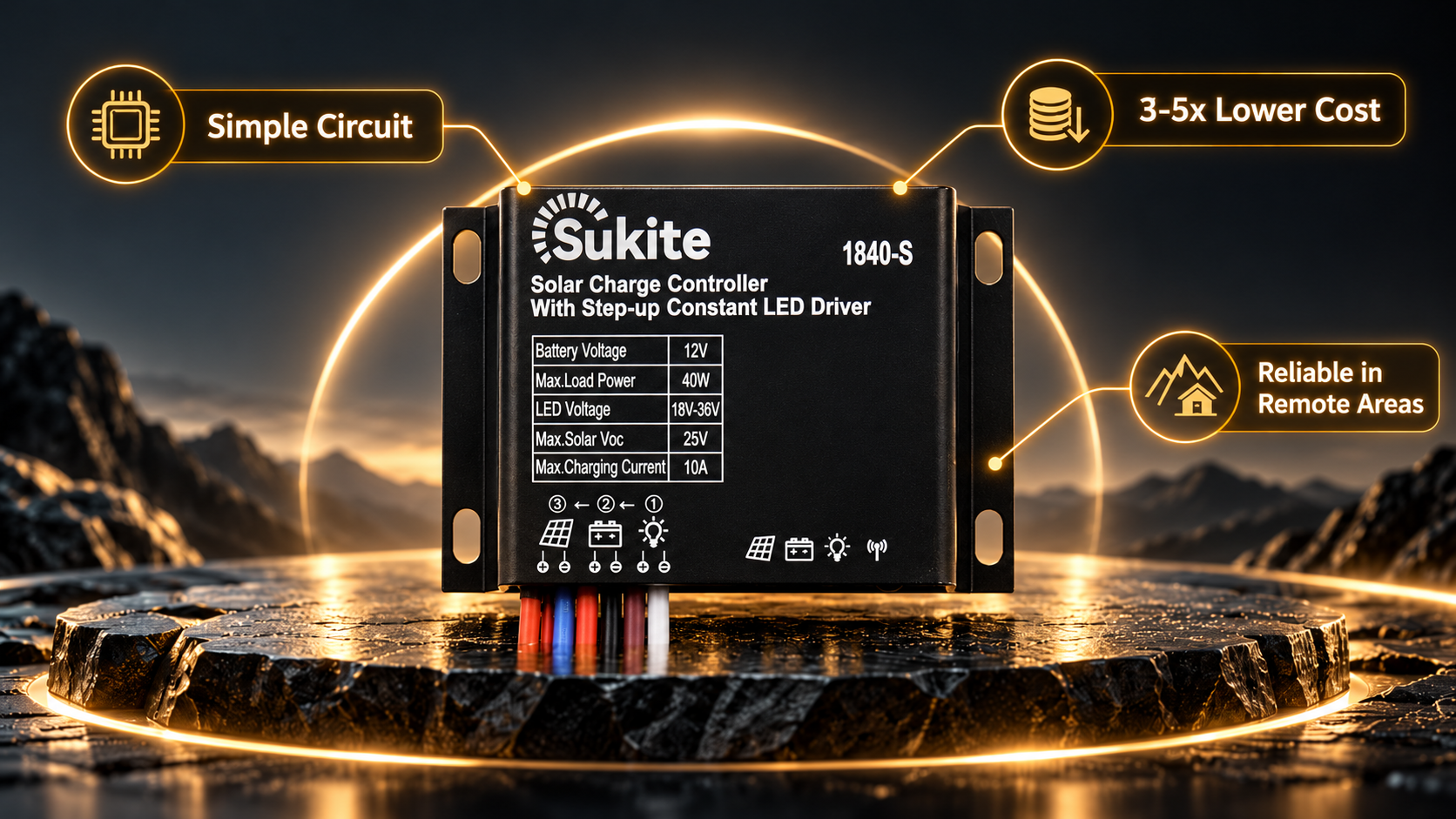
The 2480-M’s core feature is its built-in step-up constant current LED driver, as indicated by the “With Step-up Constant LED Driver” designation on the product panel.
The LED output voltage range of 30V to 48V means the controller can boost the 24V battery voltage to the operating voltage range required by LED strings. In real-world operation, battery voltage fluctuates with charge/discharge state; driving LEDs directly would result in highly unstable brightness and power consumption. The 2480-M‘s step-up constant current driver boosts and stabilizes the fluctuating battery voltage to a set value, delivering constant current output that ensures consistent driving conditions for the LED string regardless of battery state of charge — preserving both illumination quality and luminaire longevity.
The maximum load power of 80W forms an excellent match with the 10A charging capability. An 80W LED luminaire adequately covers medium-power lighting scenarios such as rural main roads, campus roads, and community road lighting, balancing brightness with energy efficiency.
The value delivered by this integrated design is multifaceted: users no longer need to separately select and configure an LED driver power supply, reducing equipment selection complexity; the 2-in-1 design reduces hardware costs including enclosure, terminals, and internal circuit boards; and fewer devices and connection points mean fewer potential failure points, significantly enhancing system reliability.
As an MPPT solar charge controller, the 2480-M incorporates a maximum power point tracking algorithm. Solar panels exhibit non-linear output characteristics, with a maximum power point that shifts in real time with changes in irradiance, temperature, and shading. The 2480-M’s MPPT algorithm continuously monitors the panel‘s voltage and current, dynamically adjusting the operating point to ensure the PV array consistently operates at maximum power output.
Compared to traditional PWM controllers, MPPT technology can improve charging efficiency by 20% to 30% , with the advantage particularly pronounced under rapidly changing light conditions. For solar-dependent off-grid lighting systems, higher charging efficiency directly translates to shorter charging times, more fully charged batteries, and longer nighttime illumination duration.
With its 24V system, 10A charging, 80W load, and 30V-48V step-up constant current driver specifications, the 2480-M offers distinct advantages in the following application scenarios:
Medium-power off-grid road lighting: An 80W LED luminaire adequately covers rural main roads, campus roads, and community road lighting needs. The 10A charging capability ensures stable system operation even in regions with moderate sunlight conditions.
Off-grid lighting in Africa and Southeast Asia: In areas with inadequate grid coverage, solar lighting systems are a basic daily necessity. The 2480-M’s 24V system compatibility and step-up constant current driver capabilities align perfectly with the medium-power solar lighting devices prevalent in these regions.
Solar courtyard and campus lighting: Outdoor lighting for villa gardens, factory premises, and school campuses typically demands higher brightness and reliability. The 2480-M‘s 80W load capacity meets the long-term operational requirements of these scenarios.
The Sukite 2480-M MPPT solar charge controller combines “24V system-specific charging + 10A charging + 80W load + step-up constant current LED driving” to deliver a highly integrated control solution for medium-power off-grid lighting applications. It is neither a standalone charge controller nor an independent LED driver power supply — it is a comprehensive control solution designed from a system-level perspective, purpose-built for real-world application scenarios.
For system integrators and contractors planning off-grid road lighting, campus lighting, or power upgrades to existing systems, the 2480-M is a practical choice worthy of serious consideration.
Model: Sukite 2480-M MPPT Solar Charge Controller
Core Functions: MPPT Maximum Power Point Tracking + 24V System-Specific Charging + Step-Up Constant Current LED Driver (30V-48V)
Target Applications: 24V Off-Grid Lighting Systems (≤80W Load)
Key Specifications: Max. Charging Current 10A / Max. Solar Voc 50V / Max. Load Power 80W
Manufacturer: Dongguan Sukite New Energy Lighting Co., Ltd. (Sukite)
Fill out the form below and our team will get back to you within 24 hours.
Your inquiry has been submitted successfully. Our team will contact you within 24 hours.