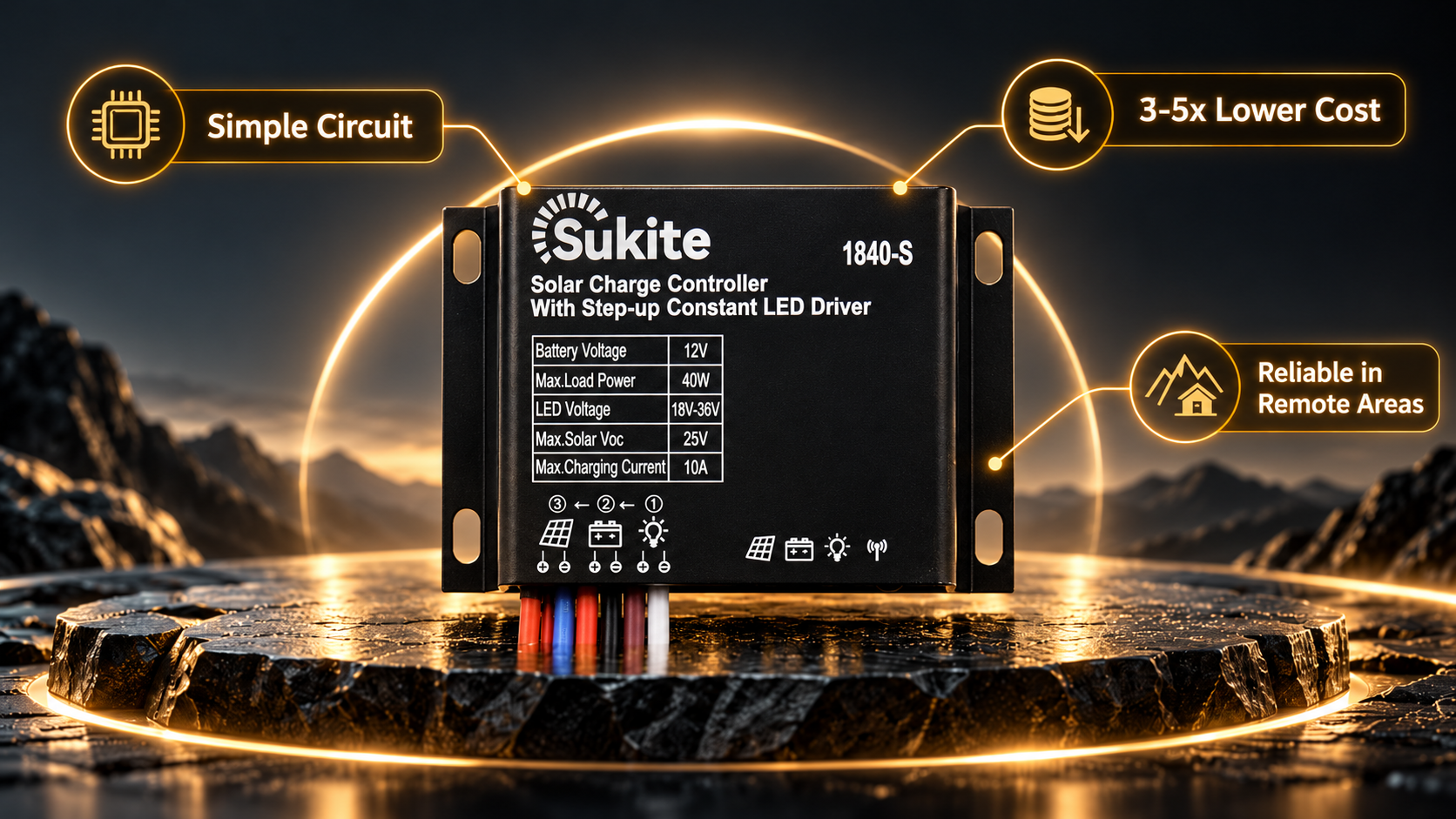


When purchasing a solar charge controller, most users focus on voltage, current, and power — the “visible specifications.” But one critical parameter is often overlooked: the IP Rating (Ingress Protection) . This unassuming number determines whether a controller survives Africa’s rainy season, Southeast Asia‘s monsoon, or the Middle East’s dust storms.
A typical comparison: a common MPPT controller on the market carries an IP32 rating — protection against solid objects larger than 2.5mm and water droplets at angles up to 15°. This means it can only withstand “vertical or near-vertical dripping water,” and its solid protection only blocks objects the size of a finger. For outdoor off-grid scenarios, the standard requirement is typically IP65 or higher. The gap between the two is the difference between “indoor use” and “outdoor all-weather operation.”
For contractors and end users planning off-grid projects in Africa, Southeast Asia, and other overseas markets, understanding what IP ratings actually mean is the first step toward avoiding the “bought cheap, repaired for months” trap.
IP ratings are defined by the International Electrotechnical Commission (IEC) under the IEC 60529 standard, formatted as “IP + two digits.” These two digits are not arbitrary — they correspond to solid protection and liquid protection respectively.
First digit (0-6) — Solid protection:
Second digit (0-9) — Liquid protection:
So, IP32 = protection against 2.5mm solids + protection against 15° dripping water. IP67 = dust-tight + protection against temporary immersion. Moving from IP32 to IP67 spans three levels of solid protection and five levels of liquid protection — an exponential difference in protective capability.
SolaX Power‘s technical guidance provides clear scenario-based recommendations:
Fully exposed outdoor (rain, snow, dust): Minimum IP65. Outdoor installations require “complete dust protection and resistance to rain from all directions.” Battery systems rated below IP65 “should never be installed in fully exposed outdoor locations.”
Marine and mobile off-grid (RV, marine, coastal): IP67 recommended. In these environments, “temporary immersion is a realistic risk,” and IP67 devices can withstand short-term immersion.
This means that if a user deploys an IP32 controller in an outdoor off-grid system in Africa or Southeast Asia, a single heavy downpour or hours of monsoon rain can cause device failure. And IP32’s “2.5mm solid protection” rating is equally insufficient in dusty environments — fine dust particles can easily penetrate the enclosure.
Africa and Southeast Asia’s outdoor environments test controllers on multiple dimensions. IP rating is just one threshold — but it‘s the one most easily overlooked.
High temperatures: Ambient temperatures in parts of Africa can exceed 45°C. IP rating itself does not measure temperature tolerance, but high temperatures accelerate seal material aging. SolaX notes that UV radiation “systematically degrades rubber and silicone seals,” causing them to “become brittle, crack, and fail.” This means that even if a controller achieves IP67 at the factory, its actual protection capability may have significantly degraded after several years if the seal materials are not UV- and heat-resistant.
Dust and sand: Africa’s fine dust particles are far smaller than the 2.5mm threshold that IP32 protects against. Once seals fail, conductive dust can enter the circuit board and cause short circuits under humid conditions. For IP32 controllers, dust ingress is not a question of “if” but “how fast.”
Monsoon and heavy rain: Southeast Asia‘s monsoon rainfall intensity far exceeds the “15° dripping water” condition that IP32 is tested against. IP32 controllers have virtually no defense against “wind-driven rain.” Even when installed inside a light pole enclosure, lateral rain mist carried by strong winds can still penetrate.
Salt spray corrosion: For coastal areas (such as Southeast Asian islands and West African coastlines), salt spray corrosion of metal terminals and enclosures is another challenge. IP67’s fully sealed design isolates salt spray, while IP32’s open structure provides no effective protection.
It‘s important to note that IP67’s “temporary immersion” test condition is 1 meter depth for 30 minutes — a laboratory-standard test, not a promise of “permanent underwater use.”
In real-world applications, the following factors can degrade IP67‘s long-term effectiveness:
Seal aging: Rubber or silicone seals gradually harden and crack under UV, heat, and ozone exposure. An IP67 product after 3-5 years of outdoor use may have an actual protection level reduced to IP54 or even lower.
Installation damage: Over-tightening enclosure screws, improperly sealed cable entries, or scratching the sealing surface during installation can compromise IP67 integrity.
Thermal cycling: Controllers cycle between high daytime temperatures and low nighttime temperatures. Internal air expansion and contraction creates a “breathing effect” that can gradually draw moisture into the sealed cavity over time.
Therefore, choosing an IP67 product is only the first step — proper installation and periodic seal inspection are equally important.
Check the specification — don‘t just look for the word “waterproof.” When a product page claims “waterproof,” you must ask for the specific IP rating. Both IP32 and IP67 can be called “waterproof,” but their actual protective capabilities are worlds apart. In B2B procurement, request third-party IP test reports directly from suppliers.
For outdoor off-grid, IP65 is the baseline; IP67 is better. If the controller will be installed in a fully exposed outdoor environment (no shelter, no eaves), IP65 is the minimum requirement. For harsh climates in Africa and Southeast Asia, IP67 provides a more generous safety margin. For coastal or marine applications, IP67 is a necessity.
IP rating is the “sealing limit,” not a “lifespan guarantee.” UV radiation and high temperatures gradually degrade seal materials. Even if the initial IP rating is high, it may decline after several years. Choosing products with UV-resistant enclosure materials and rational thermal design is more important than simply chasing a higher IP number.
Installation method affects actual protection performance. Even if the controller itself achieves IP67, if cable entries are not properly sealed or enclosure screws are not tightened to the correct torque, actual protection capability will be significantly compromised. Proper installation workmanship is the prerequisite for realizing IP67 performance.
In an off-grid solar system, the controller is the “brain.” But in an outdoor environment, that brain must first be able to “survive.” The IP rating is its first threshold for survival.
When users in Africa’s rainy season, Southeast Asia‘s monsoon, or the Middle East’s dust storms expect their systems to operate reliably, the difference between IP67 and IP32 is the difference between “it works” and “it doesn‘t.” For controller manufacturers, the IP rating is not marketing rhetoric — it is a fundamental promise that the product can survive in the real world.
Fill out the form below and our team will get back to you within 24 hours.
Your inquiry has been submitted successfully. Our team will contact you within 24 hours.