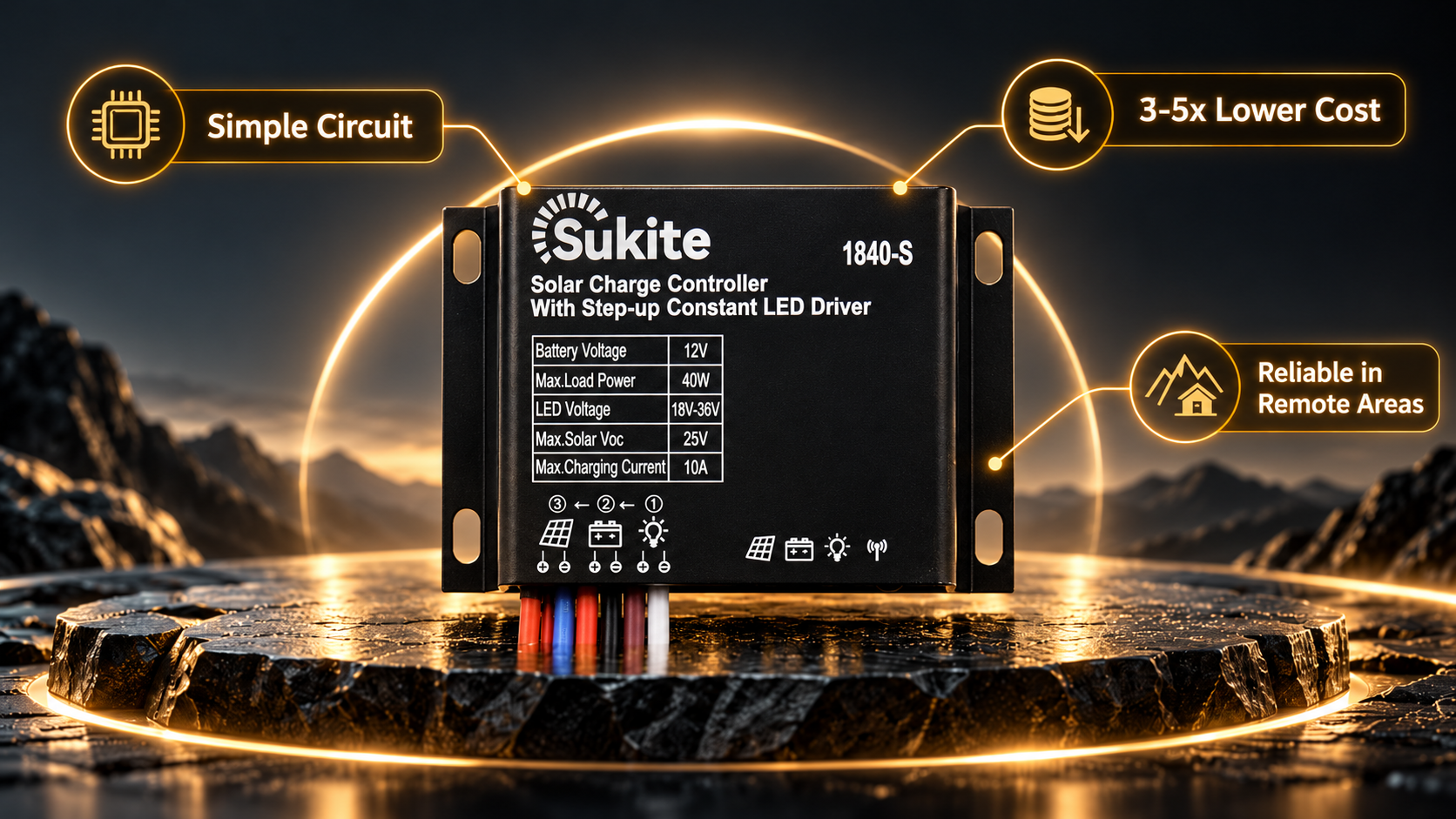


In the real-world operation of solar street lights, an unavoidable reality persists: consecutive overcast days, insufficient winter sunlight, or installation site shading can all lead to insufficient battery charging, ultimately affecting nighttime illumination. For scenarios with strict lighting continuity requirements — urban secondary roads, campus main roads, border patrol routes — pure solar power carries a “blackout risk.”
AC/DC Hybrid Complementary Power is a technology designed specifically to address this pain point. Simply put, it gives solar street lights two power sources simultaneously: solar (DC) priority, mains (AC) backup. When solar charging is insufficient, the controller automatically switches to mains power to supplement the battery or directly power the load, ensuring the street light system operates stably under any weather conditions.
The core logic of AC/DC hybrid complementary power can be summarized in eight words: solar priority, mains backup.
When sunlight is sufficient, the controller prioritizes solar energy for battery charging, maximizing clean energy utilization. When consecutive overcast days or insufficient sunlight cause battery voltage to drop below a set threshold, the controller automatically switches to AC mains input to supplement the battery or directly power the load.
This process is not a simple “on/off switch.” Patent literature shows that advanced hybrid controllers employ a gradual switching mechanism: when PV supply is insufficient, the AC current gradually increases while the PV current gradually decreases, then fully switches after reaching a threshold — achieving seamless transition with no brief interruption to the load. When sunlight returns, the system smoothly switches back to solar power in the same manner.
The significance of this “gradual switching” lies in avoiding the momentary power loss, arc sparks, and contact wear that traditional relay-based switching can cause. For LED street lights, momentary power loss not only affects lighting experience but can also accelerate luminaire aging through repeated on/off cycles. The smooth switching mechanism fundamentally resolves this issue.
Depending on the technical approach, AC/DC hybrid complementary power is implemented in three main ways:
Approach 1: Battery supplementary charging. When solar power is insufficient, mains power directly charges the battery, keeping it in a fully charged state every day. This approach has lower efficiency (longer AC-DC-battery-load conversion chain) but higher reliability and the lowest cost. It suits scenarios that are cost-sensitive and do not require extreme efficiency.
Approach 2: Low-voltage DC light source switching. When battery voltage drops to a certain level, the system switches directly to mains power. This approach operates completely independently of the battery — even if the solar PV system fails, the street light still works. However, the AC/DC converter requires higher power ratings to match the load‘s peak power.
Approach 3: High-voltage AC light source switching. Uses traditional 220V AC ballasts to form the light source. This approach offers the highest reliability because 220V AC electronic ballasts are mature, draw low current, generate less semiconductor heat, and have long lifespans. The downside is that the inverter reduces system efficiency (approximately 85%) and requires additional AC luminaires.
Adopting hybrid AC/DC power for solar street lights has practical and economic significance for promoting solar street light adoption.
Core value: reducing system configuration costs. If a pure solar street light is required to operate normally through consecutive overcast days, battery capacity and solar panel power must be significantly increased, driving up costs. With hybrid power, PV array and battery capacity can be sized smaller — essentially achieving “charge the battery with solar power during the day when there’s sunlight, discharge the battery to light the load when it gets dark.”
Actual effect: solar most of the time, mains some of the time. In most regions of China, there are more than two-thirds sunny days per year. This means the system uses solar lighting for over two-thirds of the year, with mains supplementing energy for the remainder. This reduces the one-time investment in solar PV lighting systems while delivering significant energy-saving and emission-reduction benefits.
Reliability assurance: mains as the “last line of defense.” If the battery fails or is stolen, the system automatically detects this and switches to mains power for the load — the load continues to operate normally. This “dual insurance” design keeps street lights running even under extreme conditions.
Economic calculation: Assume a pure solar street light system configured with a 200Ah battery and 300W solar panel to guarantee operation through 5 consecutive overcast days, costing approximately 3,000 RMB. With a hybrid AC/DC solution, the battery can be reduced to 100Ah and the solar panel to 150W for daily needs, costing approximately 1,800 RMB — a 40% saving. Although a small amount of mains electricity is consumed annually (assuming one-third of the year on mains, 10 hours of nightly lighting, 80W load, annual electricity cost approximately 100 RMB), the significant reduction in initial investment makes the overall cost more favorable.
Taking SRNE‘s solar hybrid street light controller as an example, its core functions include:
Automatic switching. When DC is available, the battery voltage drops to the DC switching point and automatically switches to DC power; when no DC is available, the battery continues discharging to the over-discharge point and then shuts off output.
Constant current control. Uses constant current rather than current limiting to ensure smooth and stable output current, reducing LED lumen depreciation and extending LED lifespan.
Intelligent power modes. Automatically adjusts load power based on battery state of charge, extending battery operating time.
Multiple protections. Including battery reverse connection protection, LED short-circuit protection, open-circuit protection, and over-temperature protection, ensuring safe system operation.
Urban secondary roads and campus main roads. These roads have high lighting continuity requirements but often lack the economics of dedicated cable installation. Hybrid solutions can achieve reliable lighting at lower cost in areas with mains access points.
Solar street lights in areas with unstable grid power. In remote areas with grid coverage but unstable supply, the controller prioritizes solar with mains as backup, reducing electricity costs while ensuring reliability.
Border patrol routes and remote highway lighting. These scenarios have strict requirements for nighttime lighting continuity, and hybrid power provides dual assurance. Even after consecutive days of rain, the street lights won’t “go on strike.”
High-latitude regions (Northern Europe, northern North America, northern China). Winter brings short daylight hours and low light intensity — pure solar systems face severe challenges. Hybrid power ensures uninterrupted winter lighting.
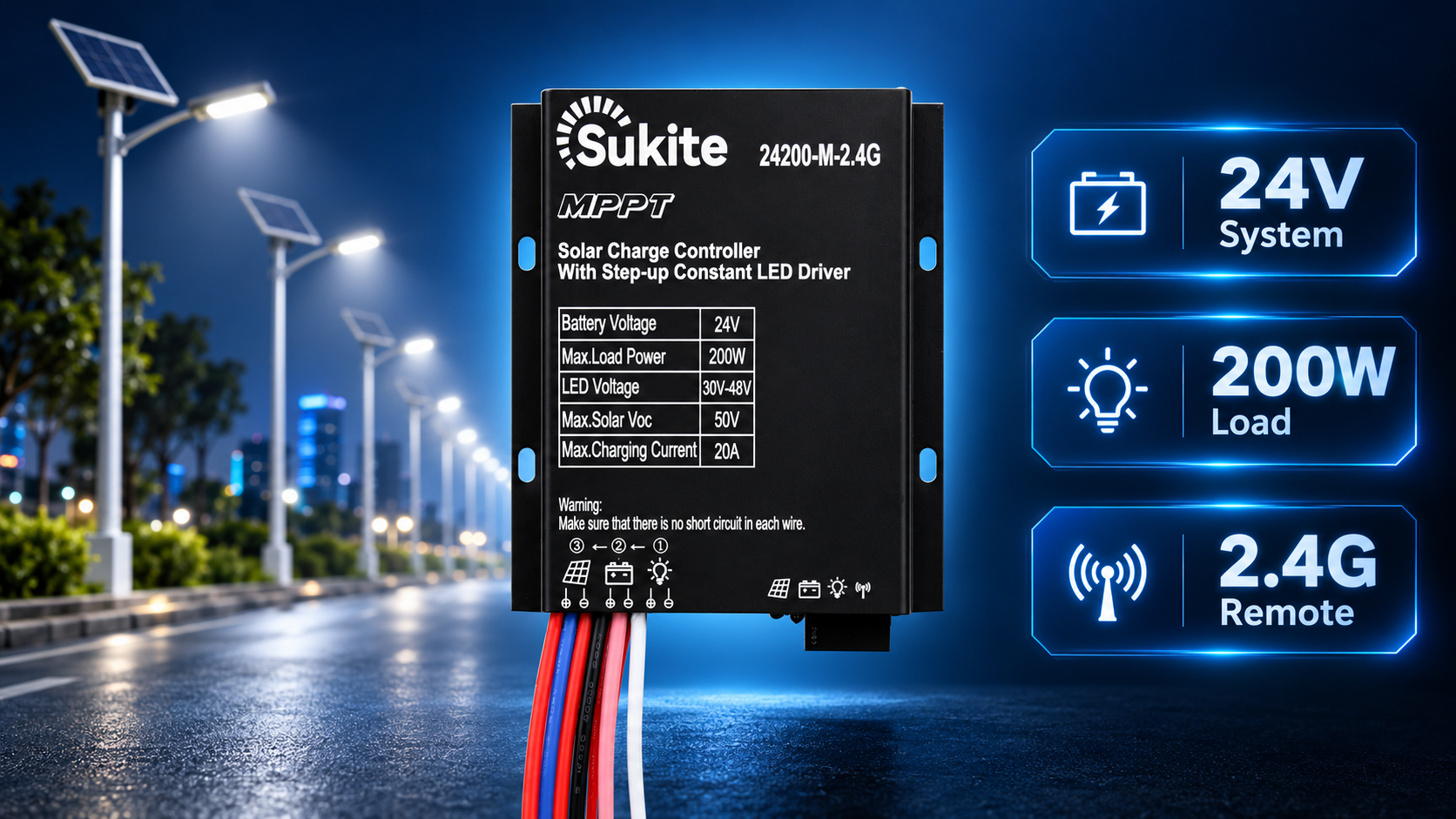
Batch street light projects requiring remote management. Combined with 2.4G wireless remote control or IoT functionality, hybrid controllers enable remote monitoring and fault alerts, significantly reducing O&M costs.
For end users and contractors, choosing an AC/DC hybrid complementary controller means:
Guaranteed lighting continuity. Regardless of weather changes, the street light system always has power available, completely eliminating the pain point of “lights out during consecutive overcast days.”
Better system configuration costs. No need to over-configure solar panels and batteries to cope with extreme weather — mains backup ensures system reliability with better overall cost-effectiveness.
More flexible application scenarios. In grid-covered remote areas, mains can be primary with solar as supplement; in areas with unstable grid power, solar can be primary with mains as emergency backup.
Lower maintenance costs. The battery operates in a shallow charge/discharge state (because mains backup eliminates the need for deep discharge), resulting in longer lifespan and lower replacement frequency.
AC/DC hybrid complementary power is not a “compromise” on solar technology — it is a rational response to actual lighting needs. Using mains power as the “last line of insurance,” it transforms solar street lights from “weather-dependent” to “all-weather reliable.” When users expect street lights to remain lit through consecutive overcast days, the hybrid controller is the silent switcher — the “unsung hero” that keeps the lights on.
Fill out the form below and our team will get back to you within 24 hours.
Your inquiry has been submitted successfully. Our team will contact you within 24 hours.