


Sub-Saharan Africa‘s off-grid solar market is set to grow 450% by 2035, with off-grid PV evolving from a “marginal supplement” to the region’s “primary electrification engine,” according to a September 2026 report from global energy research firm Wood Mackenzie titled Off-grid solar PV in Sub-Saharan Africa: a multi-gigawatt growth opportunity. Nigeria is expected to account for nearly 35% of regional off-grid solar installations, while the Democratic Republic of Congo emerges as a new hotspot driven by mining-linked solar pipelines.
The report’s core finding is that the growth logic of Sub-Saharan Africa‘s off-grid solar market is undergoing a fundamental shift. Sohan Gwalani, Research Analyst for Middle East and Africa Renewables at Wood Mackenzie, noted that in markets like Nigeria and the DRC, “the bulk of the capacity growth is driven by larger commercial, industrial and mining loads, because that is where diesel costs are highest and the economic case for solar is strongest”.
This assessment is corroborated by data. According to Ember analysis, Nigeria is projected to install 1.7 GW of solar capacity in 2026 — equivalent to approximately 40% of the country‘s available grid power. Since the removal of fuel subsidies in 2023, diesel self-generation costs have soared, making solar-as-a-service economically competitive. For commercial and industrial users, displacing even 25% of load with solar delivers immediate savings, with many developers providing PV systems at no upfront cost.
Meanwhile, the DRC’s copper belt is seeing a rapidly forming solar project pipeline. The Kamoa-Kakula copper complex‘s 233 MWp solar + 526 MWh storage project entered commercial operation in August 2026, delivering at least 30 MW of stable baseload power to displace diesel generation. Wood Mackenzie notes this demonstrates that renewable baseload power can now compete with and displace diesel in heavy industry.
Falling costs are a key enabler. The report shows that Sub-Saharan Africa (excluding South Africa) has imported over 27 GW of solar modules since 2022, with declining module costs expected to sustain this trend through the decade. Meanwhile, “value stacking” models — bundling financing, equipment, and services with energy sales — are transforming off-grid solar from a simple product into a platform business, making more projects bankable.
However, financing costs remain the binding constraint. Gwalani told pv magazine that capital cost and availability in African markets are severely constrained, with currency depreciation and borrowing costs exceeding 30% making upfront-heavy solar and storage assets extremely expensive to finance. The report argues that overcoming this depends less on subsidies than on financing structures that reduce the cost of capital — blended finance and development-finance guarantees that de-risk private lending.
For solar charge controller manufacturers, the report sends clear signals:
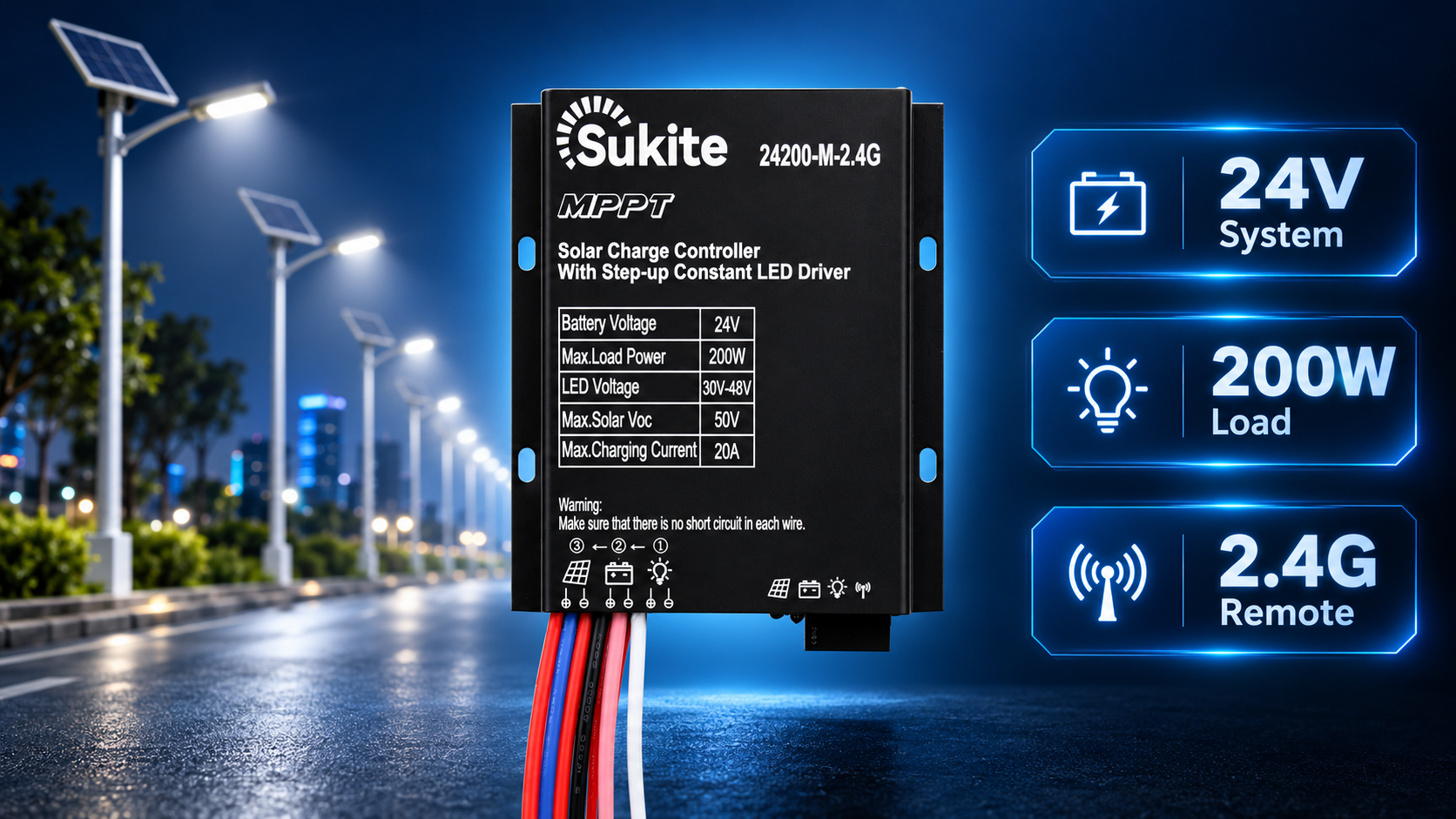
Commercial and industrial off-grid scenarios = demand for higher-power-class controllers. Unlike traditional household off-grid systems (12V/24V, low power), the growth engine in Nigeria and the DRC is commercial, industrial, and mining loads. This means controllers must adapt to higher system voltages (48V and above), larger charging currents, and more demanding industrial environments. Sukite‘s MPPT product line, with its wide voltage input range and lithium compatibility, provides the technical foundation for entering this market.
Solar-as-a-Service models require controllers to support remote management. The Solar-as-a-Service and PAYG models mentioned in the report fundamentally rely on remote monitoring and billing capabilities for distributed assets. As the “brain” of the system, controllers need IoT connectivity, data reporting, and remote control functions to support the scaling of these business models.
Financing is a short-term constraint, but demand certainty is high. Wood Mackenzie explicitly states that whether the market achieves 450% growth “does not depend on demand, which is not in doubt,” but on the emergence of effective private and blended finance models. For controller suppliers, this means partnering with developers and distributors that have local financing capabilities, rather than relying solely on product exports.
Data Sources: Wood Mackenzie Off-grid solar PV in Sub-Saharan Africa: a multi-gigawatt growth opportunity (September 2026), Ember & African Tech Futures Lab analysis, pv magazine International, Ecofin Agency.
Fill out the form below and our team will get back to you within 24 hours.
Your inquiry has been submitted successfully. Our team will contact you within 24 hours.